Stockton Federation of Teachers
Spring 2026 Newsletter
Table of Contents

Spring 2026 President’s Update
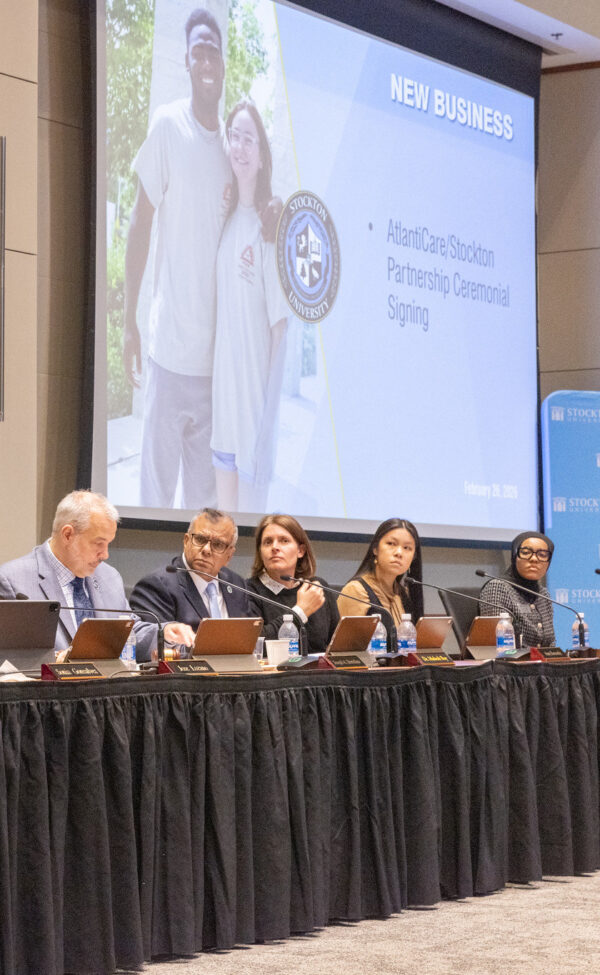
In the past year, we’ve seen an erosion of trust in public education, cuts to necessary funding at both the national and state level occurring at the same time as the impending enrollment cliff that we have been warned about for the better part of two decades, that is now upon us. This impacts the overall shape of higher education in general, and closer to home our own institution, which has become even more evident in the past several weeks. Last week, President Bertolino sent the community an email that provided more details about the state of our institution, and we received some troubling news about a plan to freeze some hiring actions and to pause promotions and reclassifications.While a clarification was later sent to indicate that this did not impact faculty, faculty only make up part of SFT. Professional staff members are frustrated, angry, and feeling extremely unappreciated when they hear that their equally well deserved promotions and reclassifications are on hold. They feel like they are being treated as less, which is not equitable, and that’s not okay. Several of our members shared their individual experiences during the public comments at the Board of Trustees meeting last week and made their feelings and experiences perfectly clear.
On Monday, SFT leadership met with President Joe and his team, and discussed the concerns we had that led up to the Board of Trustees meeting on Thursday. I came from that meeting believing that our concerns had been heard and that our members’ experiences had been seen, and I am hopeful that this has made an impact. Staff should not have to have their reclassifications or promotions paused, and we are following up with Council to ensure that our contract is being followed.
We also talked about the state of the university’s budget, and we asked to be part of the process moving forward. We reiterated that after our initial offering of the Voluntary Separation Incentive Program, our expectation is that the next round of cost-savings should come from management. We will continue to advocate for our members every step of the way, and I will continue to update you as information becomes available.
Have a great summer.
SFT's Approach to Local Bargaining in 2026 & Negotiations Updates
Recent Accomplishments
NTTP Promotions
A higher range increase when they are promoted.
Extracurricular Student-Centered Work
New agreement for Living Learning Communities for faculty working with students through Residence Life.
Adjunct Faculty
A new tuition waiver program for themselves and dependents, broadly defined.
Educational Opportunity Fund (EOF)
Maintained the prior pay structure for faculty for this summer bridge program.
All Faculty
A new Faculty Evaluation agreement, to be rolled out shortly for the 2026-2027 AY. Highlights include realignment and streamlining of review cycles with fewer due dates and easier to follow personnel actions calendars, a reduction of required peer observation reports, ability to apply for promotions simultaneous to multi-year contracts for NTTP faculty, an extended time period giving tenure-track faculty 8 additional months to submit their tenure files, getting rid of school standards so faculty have to meet only program and university standards, new feedback review cycles for probationary faculty not going up for contract renewals to, streamlined templates, clearer guidelines for file contents, and more.
Professional Staff
The negotiation team is currently working to update the Evaluation of Professional Staff and Performance-Based Promotions Procedure agreements – as many of you heard at the BOT meeting on Thursday May 7th. Feedback from staff highlighted concerns with the current evaluation process, including the consistency and usefulness of supervisory feedback, instances where evaluation materials may not be thoroughly reviewed, and a lack of meaningful engagement with discussions around longer-term contract considerations. In response, proposed updates aim to enhance the evaluation framework by providing clearer guidance and more meaningful feedback to support staff development. These revisions are also intended to better prepare employees for reappointment reviews and to establish a centralized resource outlining the criteria and expectations for those staff applying for a Performance-Based Promotion. Importantly, the staff evaluation process will move to a new platform, and our union team has been working side-by-side with HR to ensure it’s a fair system and that the transition is smooth.

Including Members in the Bargaining Process
Bargaining is a big part of what unions do, yet most of you are not involved in that process. A lot of the work that we do might seem invisible. While SFT does bargain with our administration in closed sessions throughout the year, we are constantly seeking your input throughout the bargaining process. You saw this most recently with our feedback sessions for the Faculty Evaluation and Staff Evaluation negotiating processes, where Tina, Kerri, Maria, and Amanda held multiple open sessions to present our initial drafts, gather your feedback, and update our language and positions on specific issues. Once those agreements are signed in May or June, we will develop and send materials and schedule workshops to review the changes and provide guidance to our members. These sessions will be designed to support faculty and staff as we navigate the revised evaluation and performance-based promotion processes, ensuring they have access to the information and resources needed for success.
Transparency is important, and we recognize that – it also takes different forms. Aside from the large open sessions this past winter and spring, we often reach out to members directly to ask questions or follow up with individuals or small groups after our meetings. Some of you have received those emails over the last few years from members of our negotiating team. It might be us asking a small group of members to review drafts of agreements that directly pertain to their job(s). It might be us keeping in close contact with some of you during the bargaining process to gather input on counterproposals. It might be us sending out a member-wide survey to ask for your views and hear about your experiences in certain roles. We used this when we renegotiated the faculty leadership positions in 2019-2021, where we pored over the results to gain insights about how to proceed in the bargaining process.
Finally, you might notice that our negotiating team members and other union leaders wear a lot of hats on campus – this is by design. We rely heavily on the networks that our union leaders have built to connect informally to our members and stay on top of labor issues on our campus. We do our best to listen to you, and we will continue to do so. While we cannot always deliver on what every single member would like us to do, we can promise that we carefully weigh the information available to us at the time to make the best decision possible given our goals, principles, and constraints.
What is the structure of bargaining at our university?
The Chief Negotiator, Tina Zappile, meets weekly throughout the academic year and summer with the university’s designated labor relations person – right now, that is Gerry Lorentz, Associate Provost for Academic Affairs. Our SFT negotiating team meets regularly and as needed to review proposals and counterproposals, discuss the priorities and needs of our members, and more. The entire SFT negotiating team is also present at negotiating sessions with management – these are scheduled throughout the year, and are sporadic, depending on what we’re actively negotiating at the moment.

What is the process of bargaining at our university?
The bargaining process starts when one side issues a demand to negotiate. Typically, the side that issues a demand will send the first proposal, but that’s not always the case. Once a first draft is circulated, the other side then meets to review it, makes decisions about what to accept and what to counter, marks it up accordingly, and then sends it back as a new draft. And that same process continues until an agreement is reached. “Table sessions” include a mix of formal bargaining and informal discussions where we learn more about each other’s interests and positions.
Principles
Principles that guide us are numerous, the primary ones being getting people paid fairly for their work, advocating for decent work conditions, and “good faith bargaining”. The union deals with the terms and conditions of our jobs, which we interpret broadly in higher education in NJ, and at Stockton University. We work hard to be good partners with other campus governing bodies and to protect and advocate for you at all times.
Cultivating Labor Activists in an Age of Austerity
I recently participated in a daylong Grievance Officer training held by AFT-National, attended by my fellow Grievance Officers from New Jersey locals across the state. Rather than offering a report-back on the granular details of the training (I doubt you’re eager to hear how we handle a Step One hearing in a formal grievance), I’d instead like to zero in on an introductory remark made by the facilitator that stuck with me.
She shared that each Union should have dedicated activists, at least a small handful of them. Activists. People who, should labor matters reach a place of absolute urgency, would be able to mobilize at least ten fellow union members around appropriate advocacy and wins for our members.
It got me thinking: what is an activist in the context of higher ed labor issues? And what would it really mean to mobilize membership, especially when the forces of capital seem eager to take an axe to the very structures of public higher education?
I’ve done a great deal of political organizing outside of our Union, typically around issues of US militarism and foreign policy, and in my experience, the best comrades in these struggles are those who—cliché incoming—have read deeply on the issues and understand their historical and political contexts.

Cultivating a strong cadre of SFT activists relies on the same. Our union succeeds only if we have a cohort of folks who are intimately aware of contemporary and historical labor issues, pitfalls in Union organizing, and the rampant history of Union-busting in the US. People who’d join me for a book club on Blue Collar Empire (which I just finished, and loved) or The Last Great Strike (next on my list), those who read Labor Notes and have a Tabitha Arnold tapestry in their house and have followed the rise of New Jersey’s own labor star Chris Smalls.
Labor nerds, in other words.
In our current juncture in higher ed, this is of paramount importance. The recent news of buyout agreements at Stockton has some of our members excited to right-size our budget, but others concerned that this is a harbinger of impending austerity. Higher ed buyouts have at times been the first step in a fast-moving process of restructuring universities: real estate deals and public-private partnerships (that death knell that often signals the selling off of the university for parts) can follow in rapid succession.
Still, unlike many of our colleagues in higher ed across the country navigating university downsizing, we are well-situated. We have a strong union with high membership rates, the basic skeleton for what we need to win. It is now up to us, the membership, to know how to leverage this infrastructure and protect our institution through the rough waters of fiscal instability that lie ahead.
Power to the People: Members Contribute to Statewide Negotiations

With our current statewide contract set to expire on July 1, 2027, AFT locals across the state are preparing for statewide contract negotiations. With help from The Council of New Jersey State College Locals, SFT 2275 and the ten other locals in our bargaining unit have begun the first two steps: holding a set of “Conversation Cafes” with our members here at Stockton, and then engaging with the other members of our bargaining unit at the Council World Cafe.
We held five Conversation Cafes at Stockton in April, one each for adjunct faculty; professional staff; NTTP faculty; faculty librarians, and tenured, non-tenured, and part-time faculty. Those who attended shared what was on their minds as we approach negotiations, including the successes and shortcomings of our current contract, and what they’d like to see our next contract cover. We thank you, members, for engaging in the process and starting us off on strong, democratic footing.
On Sunday, April 26, we met with the other members of our bargaining unit for the Council World Cafe at the American Hotel in Freehold, NJ. Here, we discussed the results of the Conversation Cafes, searching for commonalities as a starting point for statewide negotiations. Thanks, also, to those who joined us here.
Over the summer, the bargaining team will use the insights drawn from these experiences to develop proposals for contract negotiations.
In the meantime, if you have any questions, please reach out to any of the SFT executives.
Financial Review Committee Report and Recommendations for Fiscal Year 2024-2025
Each year, the union’s finances are reviewed by a committee of our members – the Financial Review Committee. We aren’t required to undergo a formal audit due to our membership size; those are only required of AFT affiliates with more than 1,000 members. They spend time looking at our records, including our bank accounts, deposits, expenses, deposits, record keeping, etc. Our committee recently finished the review of our 2024-2025 financial year and their report is below.
Report of the Financial Review Committee
We have examined the financial records of the Stockton Federation of College Teachers (SFT), Local 2275, for the period July 1, 2024, through June 30, 2025, and found them to be in good order. This examination was performed by a committee composed of members of the Stockton Federation of College Teachers and was not conducted in accordance with generally accepted accounting principles.
Based on our examination, we consider the attached financial statements for the period July 1, 2024, through June 30, 2025, to be an accurate summary of transactions conducted during that period.
Sincerely,
What's Goin' On?
Upcoming events we look forward to are:
May Day Payday Party
Friday, May 1st, 2026 – No, it’s not a payday, but we’re gonna party!
End of Year BBQ
Thursday, May 21st, 2026 – We will celebrate the end of the academic year after commencement and final grades! Woohoo!

Editor's Notes
Greetings all, please enjoy the new format for the SFT Newsletter. If you notice any errors or omissions, or have feedback on the design, please reach out. We want this newsletter to be accessible and work well on as many devices as possible.
Please email me at [email protected]